
What Sit-on-top Kayak to Buy?
Choosing a sit-on-top kayak and equipment.
I often get asked about buying a sit-on-top kayak. Here is some advice on choosing a sit-on-top kayak, equipment and things to consider so you’ll make a better choice when faced with what can appear to be a bewildering range of sit-on-top kayaks and equipment.
Sign up for our kayak courses to get the most out of your kayaking around the superb coastline of Jersey. We offer reduced prices if you have your own kayak and kit.
Not all kayaks are the same. What is good for one person may not be suitable for another. This is a good reason to sign up for a kayak course or, join our free kayak safety skills classes and learn from local experts.

Buy directly from the author
Buy: Sit-on-top kayak, a beginner’s guide by Derek Hairon. Full of top tips to help you make the right choices and how to improve your paddle skills. Published at Pesda Press.
Deciding what Sit-on-top kayak to buy is never an easy matter.
Your weight, height and the kayaking you plan to do are things to consider.
Retail outlets-Where to buy from?
Why buy from a specialist kayak shop rather than online or via a discount or non-specialist store?
Put simply, some retailers may not know much about the products they sell. They may have little knowledge of kayaking and often will not be able to give you much advice. Online stores make it hard to try out kayaks and kit. If it’s the wrong size it will be a lot of hassle to exchange. Go to a specialist kayak retailer.
Cheap sit-on-top kayaks are often made of poorer-grade plastic, so they may not be very good value. We have heard some horror stories about very cheap designs that easily break and fittings that fall apart.
Specialist kayak shops are more likely to know a bit about the kayak you want to buy and are often staffed by people who go kayaking. You might even be lucky to find one who will let you try before you buy. They usually sell quality products with good after-sales support.
What Sit-on-top kayak to buy? Tips to help make better decisions
How often will you go kayaking?
An odd question but one worth thinking about. If you only go afloat four times a year, then it may be better to rethink whether buying is the best option in the long term. How about signing up for a kayak class, tour or a course where all kit is supplied? This will help you compare kit and discover what is best for you. Plus, you’ll get lots of advice and top tips from people who know about kayaking which may help you make a more informed choice.
We offer kayak courses, tours and 1:1 training.
What kayaks do we use?

Scupper Pro and Prowler 13 and 15
We use Ocean Kayak Scupper Pros. They travel well in a straight line and are faster and more stable. You can see the full range of Ocean kayaks on their website. The Scupper Pro is now difficult to obtain, so we use the RTM Tempo, which is similar and equally good.
One of the reasons we chose the Tempo and Supper Pro is that they handle well and allow paddlers to develop good technique. They are also quite fast and track well, which makes them great for coastal tours. Shorter kayaks tend to turn a lot.
We also use Tootega Prophecy 135 kayaks for larger paddlers. Previously, we used Prowler 13ft (4.1M) and 15ft (4.3M) models but found the keels wear out when dragged up the beach. Getting replacement rubbing strips was not easy. If you must drag the kayak, do this so the bow is dragged on the sand, as it causes less wear and is also easier to repair.
The Tootega Prophecy 135 is made in the UK and fits a wide range of paddlers. It is also quite fast and gets good reports from our entry-level paddlers. It’s well worth looking at.
Larger paddlers and kayak fishing
We have used both Prowler 13-foot and 15-foot kayaks. The Prowler 15 handles better but is a bit more awkward to store and transport due to its length.
The Prowler Elite received good reviews. The 13-foot Prowler kayak is one of the best-selling sit-on-top kayaks in the UK.
Longer kayaks tend to be more directional than shorter kayaks
Short kayaks are great for turning and nipping in and out of rocks but are harder to paddle over a distance. Short kayaks can be quite wide. When the width and shortness are combined, a kayak is often harder work to paddle any distance.
Rod holders can easily be retrofitted, and it is worth remembering that all rod holders, depth sounder/fish finder fittings, etc., come with a cost.
What do you want to use the kayak for?
If it is just a floating platform to play on in the bay with the children, then short boats are fun.
Opt for a longer sit-on-top sea kayak if you want to paddle distances.
Children’s kayaks and kit
How would you feel using gear that is two or three sizes too large for you?
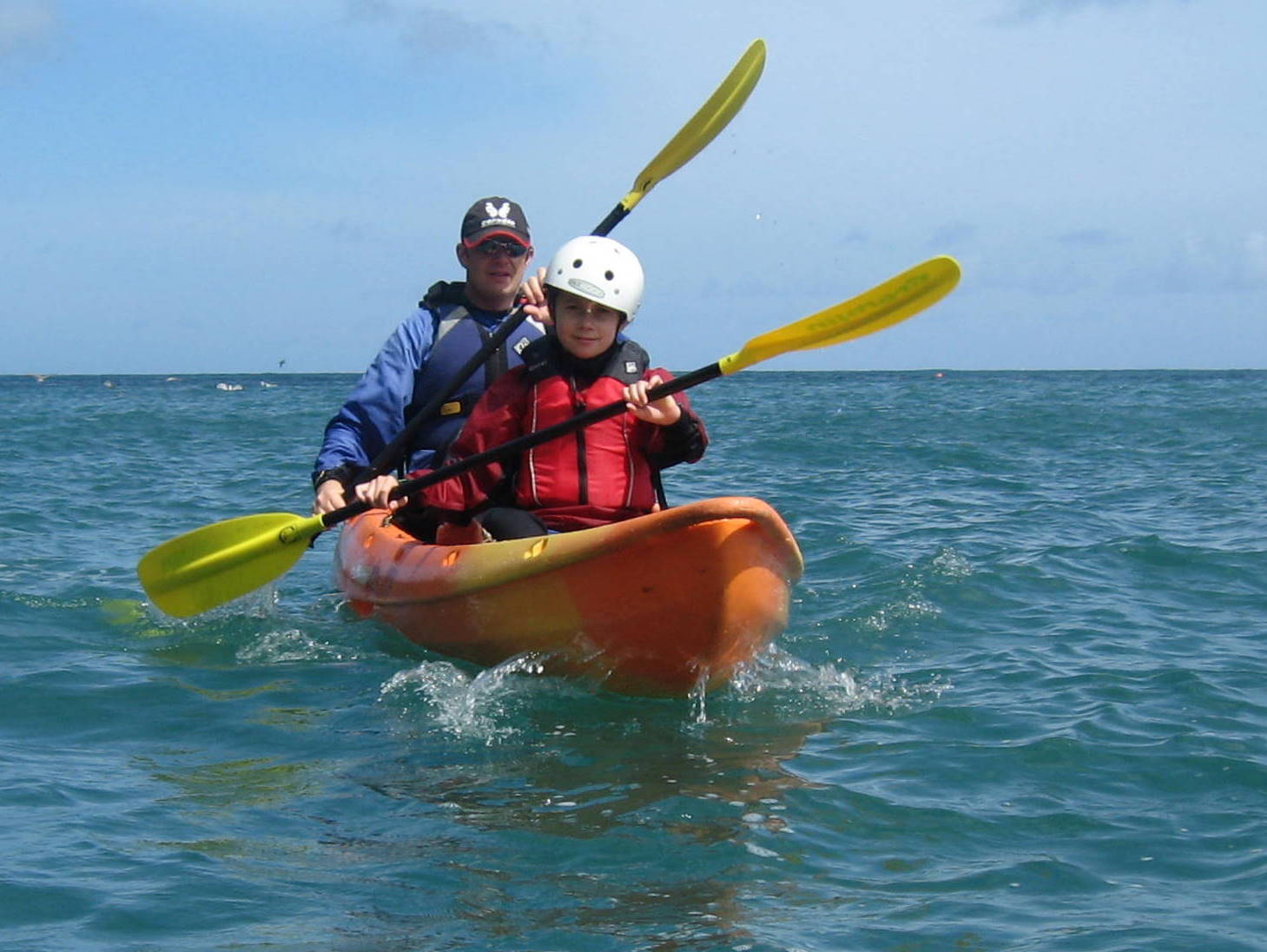
Children need the correct-sized kit
Try to buy appropriately sized kit and kayaks for children. They will have more fun and are more likely to continue kayaking.
We use Ocean Kayak Kias and the RTM version for children under ten years.
Fatyak kayaks are good value and fun on the beach and in small surf. We tested the basic model, which was popular with children and a great platform to have fun on. Tootega also has smaller-sized kayaks, which seem to be very good.
Stuart sells children’s Wetsuits at great prices at Gone Paddling in Jersey. Wetsuits keep children warm, protect them from the sun, and give them a bit more protection from bumps and bangs. Read my article about kayaking with children.
If youngsters are going to play with the Sit-on-top kayak, consider a flat stern to slide over. Ensure there are no sharp edges that could rip wetsuits (or skin).
Try before you buy
What feels like a very stable kayak the first time afloat may feel like a barge as you develop your skills. This is a good reason to avoid rushing out to buy a kayak. Sign up for a kayak course or try a kayak session to get a chance to try different craft.
Prices vary a lot. Buy from a specialist store. They will have a better idea about the product. Some shops do not know much about what they are selling.
Take care when buying second-hand. You could be buying a stolen craft. Check for wear and damage, especially around the keel (a very hard place to repair unless you have access via the rear hatch) and the drain holes. We have noticed that the seam can be damaged and leak if you do not correctly fit some trolleys through the drain holes. Repairing a leaking drain hole can be very tricky. You can spot if there might be a leak here by looking for any telltale signs such as mould growing or moisture.
If you plan to buy secondhand, check the current retail price so you know the latest new price.
Buy Local
Local suppliers will know the products and be able to sort out problems. This also helps keep cash on Jersey or your local economy.
Who do we buy kayaks and gear in Jersey from?
We often buy from Stuart at Gone Paddling in Jersey. He is a kayaker and sells quality gear. He is also very competitive on pricing. 07797728040.
Please mention us as if you buy from him.
Kayaking Gear
What paddle to buy?
Paddles are your engines. Make the right choice to get the most out of your kayaking.

Buy the correct paddle length, blade area and shaft diameter
Lightweight paddles are less tiring to use.
Large blade areas provide plenty of power but can be more tiring. Experienced paddlers often use them as they provide plenty of power and connectivity with the water. However, some argue this increases the risk of injury, slows your paddle speed (cadence) and leads to more effort.
Avoid long paddle lengths. Gone are the days when we selected a paddle by standing and putting our fingers to the top to choose the right size. Nowadays, shorter lengths are popular because they reduce the strain on your body and let you paddle with a higher cadence (it’s a bit like spinning the pedals on a bicycle when in first gear) and less effort. I’ve gone from 225cm down to 210-215cm, and sometimes, in rougher water, even shorter.
Many sea kayaking paddles are elongated to give a more gentle action. The argument is that this makes for a ‘lower gearing’ and easier paddling over any distance.
People often talk about low and high-angle paddling styles.
Low-angle paddling may seem less tiring, but it is a less efficient and responsive method of paddling, and it can indicate poor technique.
If you learn a high-angle paddle style, switching to a low-angle style is easy when conditions demand it. It is harder to move from a low-angle to a high-angle paddle style. Learning a high-angle paddle style will teach you to use your legs and core muscles more to drive yourself through the water.
Flat or feathered? The angle you select influences the way you paddle. 50-70 degrees of feather is probably more suited to high-angle paddlers using narrow sprint racing kayaks or high-performance surf skis, allowing them to put the paddle almost vertically in the water. Most sea kayaks and sit-on-tops are wider, so less angle works well. I paddle with around 35 degrees of feather. When paddling my surf ski, I sometimes have a bit more angle because the ski is narrower.
Learn good forward paddling techniques.
There is a difference in blade areas available for children and women.
What paddles do we use?
We also use Werner Tybee paddles. All have adjustable feathers, and some allow us to change the shaft length. Their light weight and strength make these designs more expensive. Werner Paddles has a very useful paddle selection FAQ section. Though expensive, Werner paddles are very well-built and robust.
Our child-sized paddles are Lendal Gremlins.
Paddles cost from £75-£300+ depending on construction. You get what you pay for.
Cagoules or paddle jackets for kayaking
We use Peak products. They are not the cheapest, but they seem to last well and withstand centre use.
It is important to have a kayak cagoule (or cag) in case it gets cooler on the water.
Wind chill is a major cause of hypothermia. A light wind will drain your body heat, so always carry some wind protection on board.
Wetsuits
Wetsuit arms can be restrictive when paddling. We use Palm long John wetsuits, which are cut for kayaking. Most of our staff use Palm wetsuits. We have Male and Female sizes as well as children’s sizes. We have started using Typhoon wetsuits, but the ladies’ sizes are on the small side, so you need to order at least one size larger. Sizing seems to vary a huge amount between manufacturers. This is a good reason to buy locally so you can try the wetsuits on for size.
If you kayak or fish all year, consider a Dry suit made by Peak, Palm, or Lomo. Prices have dropped a lot in the last few years, and they are now a very good investment. In an emergency, they are a lifesaver, especially if you paddle in cooler waters.
Kayak trolleys

Save your back on long walks down the beach with a kayak trolley
The Eckla trolley (which plugs into the holes on the Scupper Pros, etc.) is not as durable as the simple Eckla Canoe trolley. We have also found that the former design can damage the seams around the drain holes if the trolley is not installed correctly. There are many other designs about.
The C-Tug trolley from New Zealand is very good but bulky. This is an excellent all-terrain design.
You can make your own with a bit of DIY. We have seen one constructed out of a plastic drainpipe that works very well and uses pram buggy wheels.
Kayak safety kit
Buoyancy aids (PFDs)
We use Peak buoyancy aids, designed for kayaking, and the Nookie NKE children’s range, which seem to last well but are pretty basic. Peak PFDs are a bit more expensive but have a more comfortable design and look great.
Buoyancy deteriorates over time. After about five years, it may have decreased by up to 50% or more.
Be very careful when buying second-hand buoyancy aids, as they may be of little use. Wash the kit after use and store it properly to prolong its life. Wear the correct size.
Carry Communication
Carry some form of communication on your person so that if you end up in the water, it is easily available. Around Jersey, a mobile phone will usually give you excellent coverage, but ideally, you should have a marine VHF radio. Ensure they are either waterproof or in waterproof bags. We have found the Overboard brand good value and long-lasting.
Tell someone where you are going, who you are with, and when you will be back. Do not forget to ensure they know what to do if you do not make contact and know who to alert.
Flares
Flares are very bright but only burn briefly, so they may not be seen from the shore. This is a good reason why carrying a means of communication to summon help yourself is sensible. Flares can be used to aid location once you have alerted the coastguard.
Flares have some downsides: they are costly, have a limited lifespan, may not be waterproof, can burn you, and are—in some areas—very difficult to dispose of safely. Never use out-of-date flares, which may have become unstable and could miss-fire.
Laser Flares
We have recently switched to using Greatland Laser flares. They are easy to use, have a long-range, are long-lasting and can be easily carried in a PFD pocket. They are good for helping to aid location once you have alerted the Coastguard. I discuss these and other location methods in my article in Ocean Paddler.
Paddle leashes and Tow Lines
If you are paddling solo, consider a leash for both you and the paddle in case you fall in. It is surprising how fast a kayak can drift away from you in even a light wind.
Buy or make a simple tow-line. This is very useful if paddling with young people who can tire easily. A tow line also enables you to moor up your kayak when invited onto yachts or when taking a walk. Just make sure you have secured the kayak in case it floats away.
Think of a tow line as a helping hand to be used if someone is finding the going a bit hard.
Practice towing so you know what it feels like. Towing is harder than many realise.
Know your limits
Get experience paddling outside your comfort zone with skilled people who can provide safety support. This is another reason to sign up for one of our courses.
Should you ever find yourself in difficult conditions, you will have some experience to draw upon.
If you can think-“Yes, I’ve experienced something like this before”, you’ll be in a better position to modify and respond to the situation.
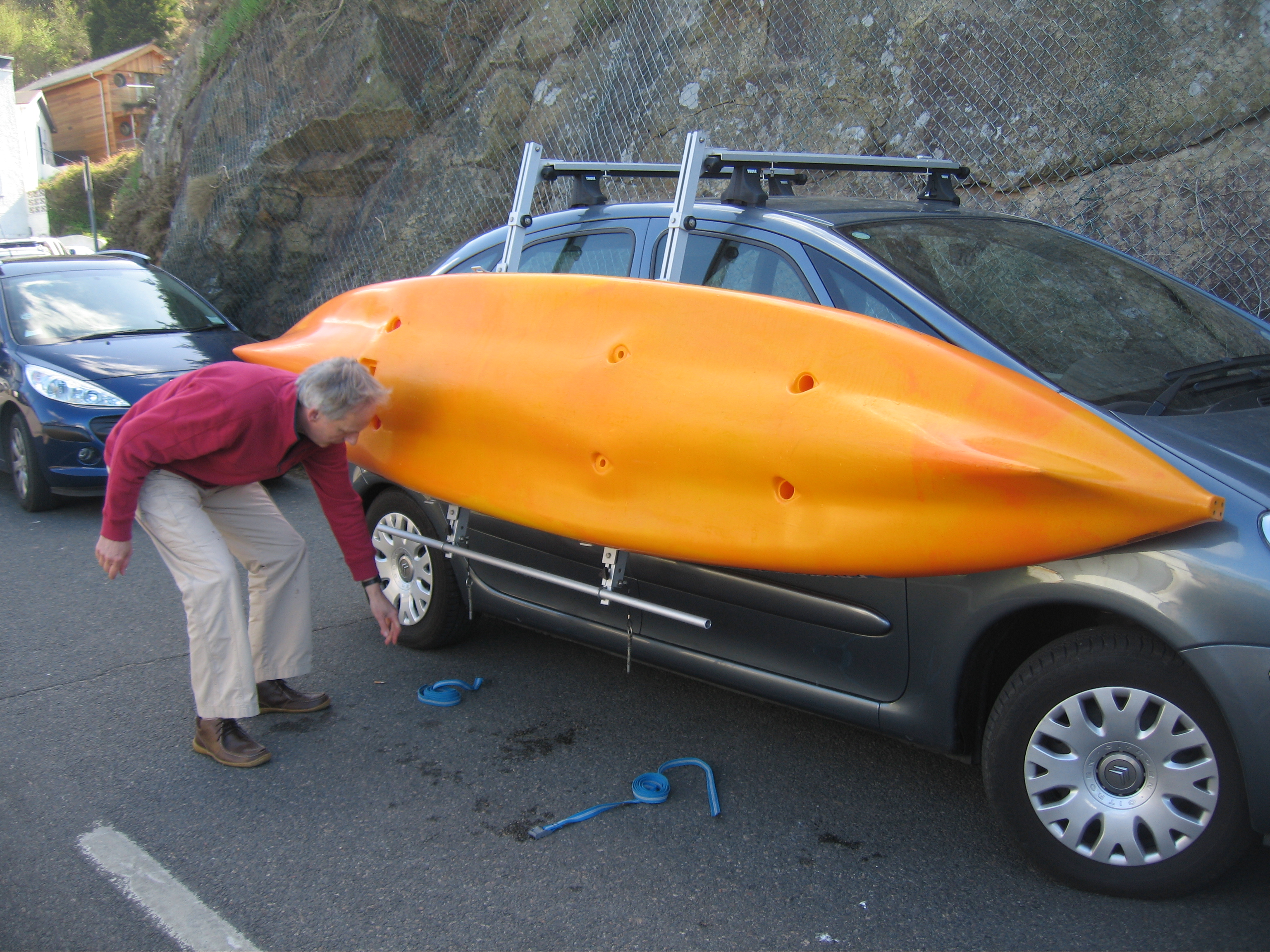
A Kari-Tek rack makes loading easier for one person
Transport and storage
Car roof rack.
A roof rack is an unexpected cost. Car roof racks and roof bars to transport sea kayaks can be very costly. All car manufacturers have a maximum loading for a roof rack.
There is the added issue of loading and unloading the kayak and the impact on your back.
Who will help you lift the kayak on and off the car? Many back injuries occur when trying to lift a kayak alone, which is a good reason to go out with others.
Some buy a small box trailer to carry kayaks and kit. This saves lifting and keeps wet gear out of the car. If you need to transport more than one kayak, look at small kayak trailers. The cost can be similar to some car roof rack systems, but there is no risk of damage to your car should you drop a kayak when lifting.
Never use elasticated “Bungee cords” to tie your kayak onto a car roof rack unless you want to see it fly off as you drive along. We have also had problems with low-priced straps that are not very strong or long-lasting. A few straps broke, so we now buy the more costly straps with a breaking strain listed. They are a bit more expensive, but at least we know our kayaks are secure.
Detachable roof roller.
On page 12 of my book, I mention a roller for attaching to the car roof rack. Sadly, it is no longer available. However, there are a couple of options.
Use the C Tug trolley upturned on the car tailgate. Attach a couple of cords running from the roof bars to the C Tug and one down to the bumper to hold it in position. The upturned wheels can now be used as rollers.
Or, look at Van Guard for roller units that attach to the roof bars.
Storing your kayak
Somewhere safe and accessible. This may not be an easy option and a good reason why some prefer to go on tours or courses where the kayak cost is included.
Sit-on-Top Kayak Courses and Training
There are also many Sit-on-top kayak forums on the internet. Most are very useful. Some who advise on these forums may not have as much experience in kayaking as you might think from their posts. It saddens me when I see paddlers spending ages discussing techniques and kit, which, had they bothered to get some advice from kayak coaches, would have saved them lots of time and cash.
Remember, those who post the most on kayak forums may paddle the least!
We run courses to develop skills and seamanship. This can include taking PaddleUk (formerly British Canoeing) awards, a standard of kayaking ability recognised worldwide.
Our kayak courses and awards give you a solid technical and practical base. My book Sit-on-top Kayak also provides lots of handy hints and tips to get the most out of your kayaking.
Remember:
Even if you invest in your own gear, we can still offer you special rates for places on our trips and courses.
The above is for information only; you kayak and use any advice at your own risk.
Get professional tuition, take courses, and learn to sea kayak. Be safe and have fun!
Derek Hairon
Updated August 2024